Blog

What is the KIIS ?
The KIIS, or Key Investor Information Sheet, is a document designed to communicate, as transparently as possible, the terms and conditions of participating in a crowdfunding project. Its purpose is to help you understand and internalize the risks, and refine your comprehension of the fundraising process. Consulting this document is mandatory in order to invest through crowdfunding, making it an essential step and one you should know how to navigate in order to invest wisely. This article will guide you through it.
The KIIS is divided into seven sections (Parts A to G), each as important as the next, as they describe the company’s context, your rights as an investor, and the risks associated with the project.
In Part A, you will find essential information about the issuer and the fundraising project. You can review the company’s financial health and the project’s solidity, helping you make an informed decision. It typically includes:
• The capitalization table (showing the ownership distribution among shareholders)
• The company valuation
• Five-year financial projections (including revenue, profit and loss statement, balance sheet, and intermediate management balance)
• A description of the project
• The planned allocation of the funds raised
• A hyperlink to the issuer’s most recent financial statement
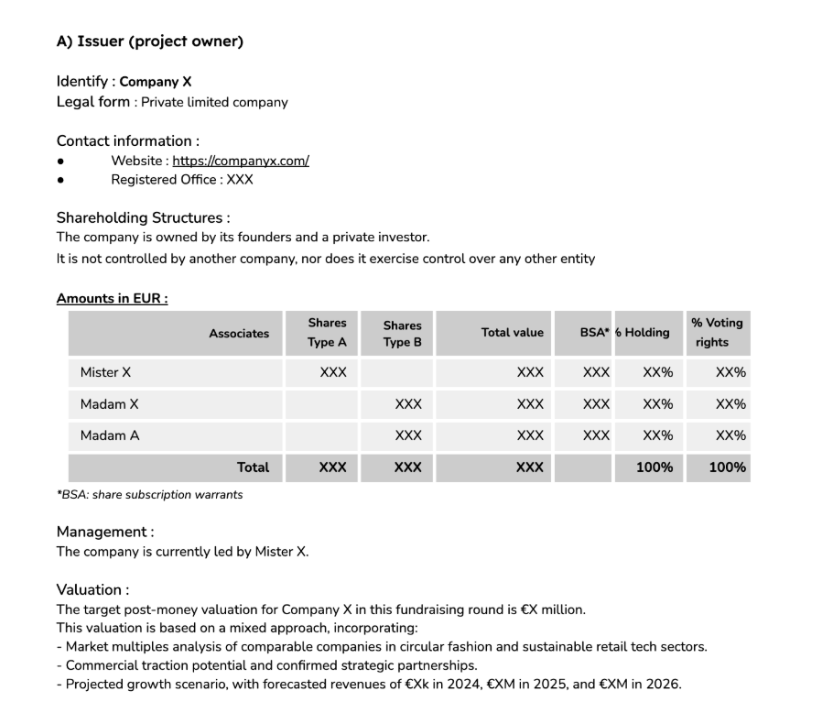
Anonymized excerpt of Part A of a KIIS
⚠️ Attention, the KIIS is not the project page. The project page is produced by the ECSP (European Crowdfunding Service Provider) and allows investors to understand the project in detail and what it aims to achieve. The KIIS is a standard document issued by ESMA (European Securities and Markets Authority), and its content and body are filled in by the company raising funds.
Part B outlines the exact terms of the fundraising and presents the main characteristics of the financing process:
• The minimum amount required for the fundraising to be considered a success (and therefore for funds to be transferred to the target company)
• The target amount needed to complete the project
• The number of previous offerings conducted by the company
• The conditions and implications of extending the fundraising period
• The post-fundraising ownership structure
• The financial terms of the bond offering
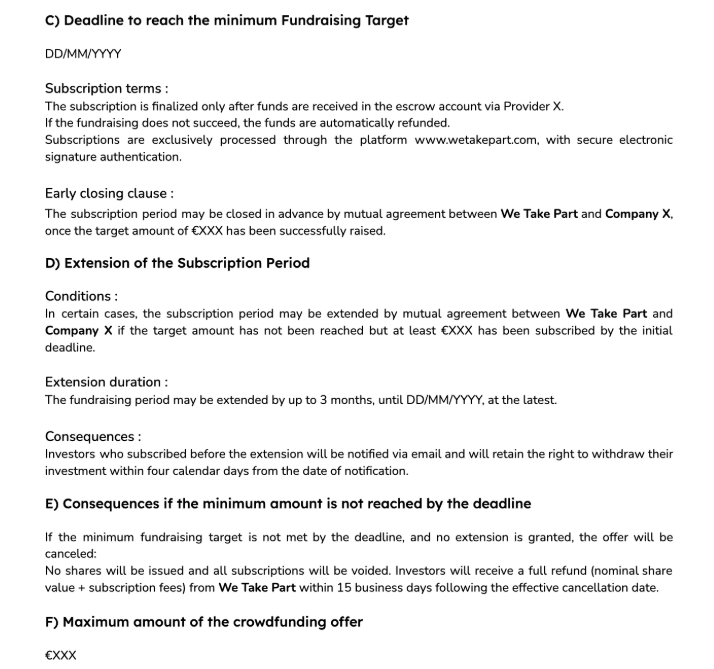
Anonymized excerpt of Part B of a KIIS
Part C deserves your full attention, as it thoroughly details the various risks related to the investment and the potential failure of the project. If Parts A and B may seem repetitive compared with the project page or the analysis you’ve already read, Part C is where you should pause to fully grasp the risks involved. Here, you can identify several categories of risks, including:
Project-related risks
• Credit risks (late payments or defaults)
• Market risks (difficulty selling products)
• Operational risks (logistical or management issues that slow down the activity)
• In specific cases such as agriculture: climatic risks
Sector-related risks
• Fragility of the sector
• Competitive pressure (e.g., a new competitor endangering or displacing the project owner)
Industry-specific challenges
• Delays in R&D, weather-related issues, etc.
Risks inherent to investing in unlisted companies
• Risk of total or partial loss of the invested capital
• Risk of lower, delayed, or no returns
• Illiquidity risk, meaning it may be difficult or impossible to resell your investment
This list is merely illustrative and does not cover all potential risks. The range of risks is wide and varies significantly from one project to another.
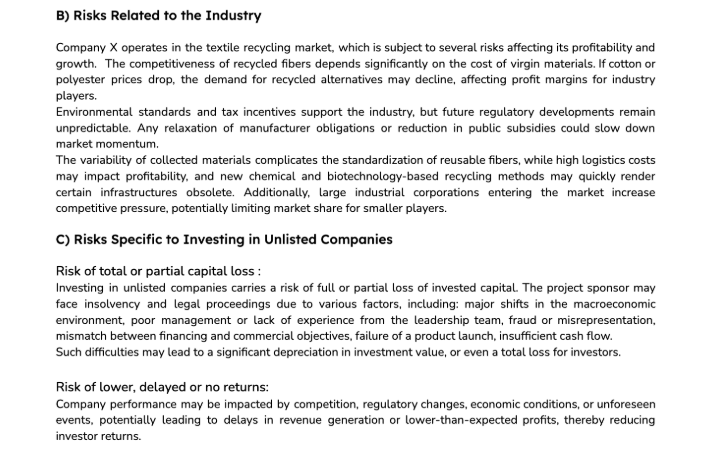
Anonymized excerpt of Part C of a KIIS
⚠️ Attention, the KIIS is only accessible to verified investors who have completed the KYC (Know Your Customer) process. Here is the link to create an account to complete it and gain access to WeTakePart's investment opportunities.
Parts D through G address the legal dimension of the project. They provide important information to help you understand your rights as an investor and the procedures in case of disputes. Part D details information related to the financial instruments. Part F outlines your rights as an investor. Part G provides clarification on fees applicable to both the investor and the project owner, as well as the legal procedures for filing complaints.
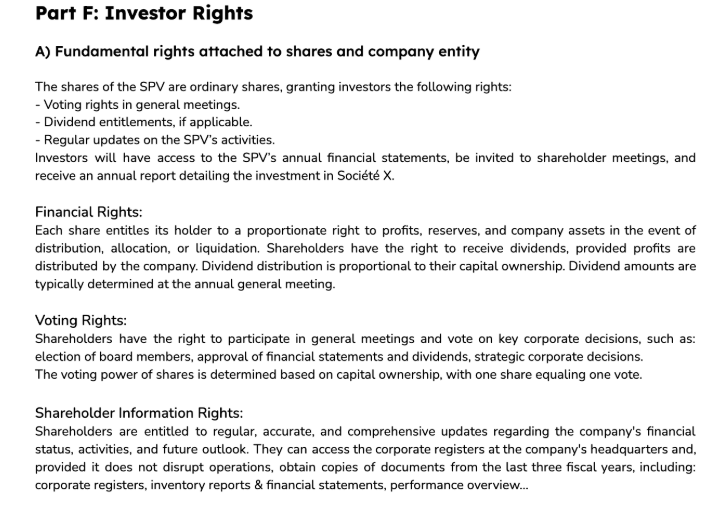
Anonymized excerpt of Part F of a KIIS
Part E gives detailed information about the special purpose vehicle, also known as an SPV. This mechanism is designed to simplify and streamline the management of investments. The SPV acts as an entity between the investors and the project owner, created specifically for the fundraising campaign. Once the fundraising is successful, the SPV receives all investments and becomes a minority shareholder of the issuing company. For instance, at WeTakePart, the vast majority of investments are carried out through an SPV.
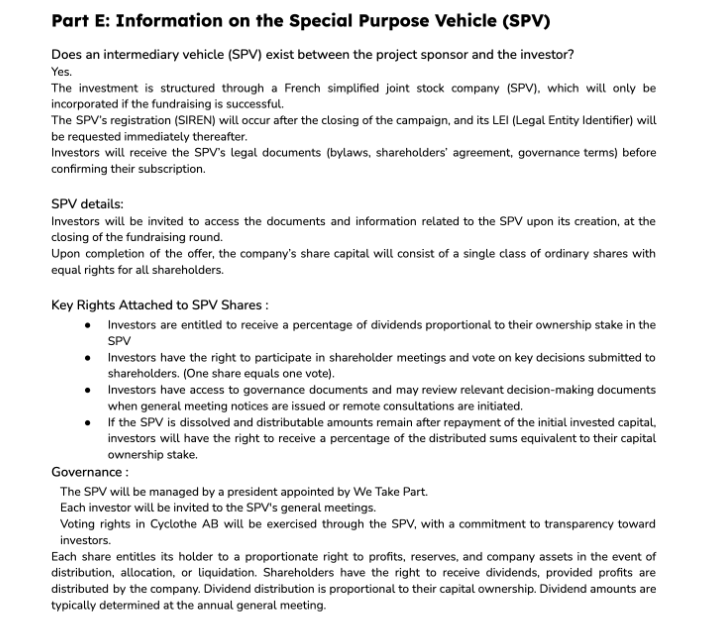
Anonymized excerpt of Part E of a KIIS
The KIIS allows you to clearly understand the structure of a fundraising operation and its conditions. You now know how to read it! All that remains is to dive into your first KIIS. Always make sure to invest with full awareness of the risks. For example, if you wish to invest only in ethical and sustainable projects, it’s essential to conduct due diligence to verify that these initiatives truly have a positive impact. This is why WeTakePart created the WeTakePart Verified label (link to relevant page or article), which certifies projects that demonstrate significant ecological impact.
Investing in startups involves a risk of total or partial loss of capital, as well as illiquidity. Only invest amounts you are prepared to lose.